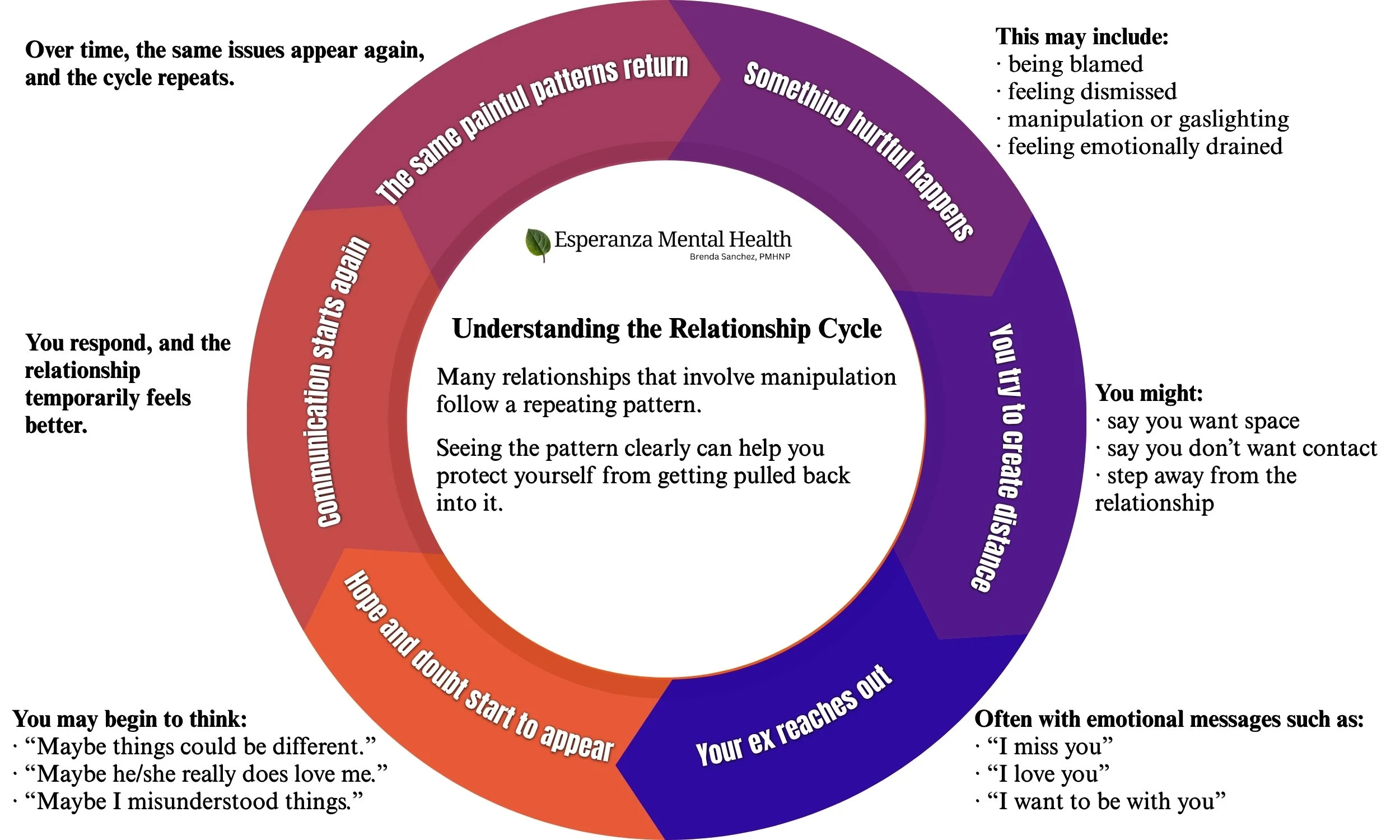
Understanding the Narcissistic Relationship Cycle: When You Start Questioning Your Own Reality
People often imagine that an unhealthy relationship is painful from beginning to end. If that were true, walking away might be much easier.
What makes emotionally manipulative relationships so confusing is that the painful moments are often mixed with intense connection, promises, affection, apologies, and hope. You are not simply holding on to someone who hurts you. You are holding on to the possibility that the relationship could return to what it seemed to be at the beginning.
I understand this cycle not only as a psychiatric nurse practitioner, but also as someone who has experienced it. Sharing this is not easy. It is certainly not one of my proudest moments. Still, it taught me lessons that shaped both who I am and how I support others today.
At the time, I was a registered nurse. He had recently graduated from a reputable university with a doctorate in advanced psychiatric nursing. Because of his education, confidence, and professional background, I trusted his judgment—possibly more than I trusted my own. Within approximately three months, he had moved into my home. We talked about getting married, having children, and creating a future together. It felt serious very quickly. Looking back, I now understand that the speed and intensity made the relationship feel more established than it truly was. We had imagined an entire future together before we had enough time to understand how we handled conflict, accountability, disappointment, or emotional safety.
Something Hurtful Happens
The relationship quickly became unstable. In less than six months, we broke up at least four times—possibly more. There were repeated arguments, emotional confusion, reconciliations, and promises that things would improve.
During one of our many fights, he calmly looked at me and asked: “Are you bipolar?”
He did not say it in anger. He asked seriously, with the confidence of someone making a professional observation. That made the question even more powerful. In a matter of seconds, my attention shifted away from what had hurt me and toward the possibility that there might be something seriously wrong with me. Instead of continuing to examine what had happened between us, I began examining myself. Was I overreacting? Was I experiencing symptoms I could not recognize? Was he seeing something that I could not see?
This is one of the most damaging effects of gaslighting and emotional manipulation. The original issue disappears, and the conversation becomes about your reaction, your memory, your personality, or your mental health.
You Begin Questioning Yourself
I am not perfect, and my life experiences had humbled me enough to remain open to honest self-reflection. My thought was simple: If it is me, I want to know so I can fix it.
Long before I met him, I already carried experiences that made me vulnerable to questioning myself.
Beginning around six years old—if not younger—I was repeatedly sexually molested by the same individual. Like many survivors of childhood trauma, those experiences shaped how I experienced emotions and understood myself. They also taught me, from a very young age, to question my own instincts and wonder whether I was somehow the problem.
I was impulsive. I experienced emotions intensely. Too many times, my actions followed my feelings before I had the opportunity to slow down and think them through. Emotional regulation was something I genuinely struggled with. Those experiences were real. Those struggles were real. At the time, however, I didn't understand why.
That willingness to look inward is generally a strength. In an unhealthy relationship, however, it can be used against you. I spent weeks ruminating on his question. I researched bipolar disorder extensively and reviewed the diagnostic criteria. I replayed arguments and examined my behavior. I wondered whether I had somehow been hiding a serious psychiatric condition from myself and everyone around me.
Intellectually, I did not believe I met the criteria. Emotionally, that was no longer enough. My confidence in my own reality had been tested so thoroughly that I needed other people to confirm what I once would have trusted myself to know.
At the time, we all worked in a psychiatric facility. I was surrounded by professionals who knew me, worked closely with me, and spent much of their time assessing and treating the very condition I had begun questioning. I remember approaching one of my colleagues with humor, which was probably my way of saying that I needed help without admitting how shaken I felt. I began asking whether she thought I could be bipolar. She quickly understood where the question was coming from and in the most loving and direct way possible, she essentially slapped the doubt right out of me.
You Try to Create Distance
One impulsive action led the other, and I told him to leave my home. That should have been the ending. But leaving physically and becoming emotionally free are not always the same thing. After he left, I reached out seeking forgiveness. Even though I had been hurt, I found myself wondering whether I had handled things incorrectly. After all, I had knowingly said and done hurtful things too. Perhaps I had been too emotional. Perhaps I went too far. Perhaps I owed him an apology. That is how deeply the cycle can alter your perspective. You may set a necessary boundary and then feel guilty for having one.
Hope and Doubt Begin to Appear
We “made up,” and for a few days, the relationship seemed repaired. That moment of reconnection gave me hope. Maybe we had finally understood each other. Maybe our problems were related to stress. Maybe we could start again and do things differently. People often believe someone returns to an unhealthy relationship because they have forgotten what happened. Usually, they remember.
They return because they also remember the affection, the plans, the promises, and the person they believed their partner could become. You are not necessarily returning to the relationship you had. You may be returning to the future you believe you could have.
Communication Starts Again
When communication resumes, the emotional pressure temporarily decreases. The person may become attentive, affectionate, apologetic, or reassuring. You may feel relieved simply because the conflict has stopped. That relief can easily be mistaken for healing.
For a few days, I believed we had repaired things. Then he abruptly ghosted me. The timing aligned with the beginning of his new role as a psychiatric mental health nurse practitioner. After the intensity, future planning, repeated breakups, reconciliation, and promises, there was suddenly silence. No meaningful closure. No healthy conversation. No accountability. Just absence. Four months later, I heard he had proposed and was soon to be married.
The Same Painful Pattern Returns
The details of each relationship may look different, but the pattern is often similar. Something hurtful happens. You attempt to protect yourself. The other person reaches out—or you reach back because the doubt has become unbearable. Hope returns. Communication resumes. The relationship temporarily feels better. Then the same painful behaviors reappear. Sometimes the cycle continues within the relationship.
Other times, the relationship ends, but the cycle continues internally. You replay conversations, question your decisions, search for explanations, and wonder whether you were the problem. That internal cycle can last much longer than the relationship itself.
Why “Just Leave” Is Not Helpful
People outside the relationship may see the pattern clearly and ask why you stayed or returned. But they were not inside the emotional experience. They may not understand how quickly the relationship developed, how much was promised, or how carefully your confidence was weakened. They may not understand that you were not only grieving the person. You were also grieving the marriage, family, safety, and future you had imagined. You may even feel embarrassed because you believe you “should have known better.”
I was a nurse. He was highly educated in psychiatric care. I was surrounded by mental health professionals—and I still became disoriented enough to question whether I had bipolar disorder because of one calmly delivered question.
Education does not make someone immune to manipulation. Intelligence does not prevent emotional attachment. Professional training does not cancel out the human need to love, trust, and believe someone.
The Question That Helped Me See Clearly
For a long time, I focused on isolated moments.
Did he mean what he said?
Was the apology sincere?
Did he truly love me?
Was I too reactive?
Eventually, I learned to stop analyzing each individual interaction and look at the pattern as a whole. A more useful question became:
How did I consistently feel in this relationship?
I felt confused. I felt emotionally destabilized. I questioned my judgment. I doubted my mental health. I repeatedly tried to repair something that continued to harm me. That pattern gave me more reliable information than any promise or explanation.
You Do Not Need a Diagnosis to Validate Your Experience
The term “narcissistic relationship” is commonly used to describe relationships involving manipulation, blame, gaslighting, lack of accountability, and repeated cycles of idealization and devaluation.
However, not everyone who behaves harmfully has Narcissistic Personality Disorder. A diagnosis can only be made through an appropriate clinical evaluation. You do not need to diagnose the other person to recognize that the relationship is harming you. You do not need proof of a personality disorder to set a boundary. You do not need their agreement to trust your experience. The label is less important than the pattern.
What the Experience Taught Me
Although the relationship was painful, it taught me valuable lessons. The most immediate lesson might be stated simply: Run the other way.
The deeper lesson, however, was learning to pay attention when a relationship repeatedly required me to abandon my own reality to preserve the connection. Healthy relationships can include disagreements, mistakes, and emotional reactions. What they should not require is the ongoing erosion of your confidence, identity, and ability to trust yourself.
A healthy partner may respectfully raise a concern about your well-being. They do not weaponize psychiatric language during an argument, use a possible diagnosis to dismiss your pain, or position themselves as the authority over your reality.
Years later—long after this relationship had ended—I would finally receive a diagnosis that made sense. I was diagnosed with ADHD. Suddenly, so many pieces of my life fit together. My impulsivity. My emotional intensity. My difficulty regulating emotions. My tendency to act before I had fully processed what I was feeling. The symptoms that had once made me question myself were eventually understood through a completely different lens. My ADHD diagnosis didn't change who I was—it helped me understand who I had always been.
Healing Means Learning to Trust Yourself Again
Recovering from an emotionally manipulative relationship is not only about getting over the other person. It is also about rebuilding the relationship you have with yourself.
You may need to relearn that your feelings are information. You may need to recognize that asking questions does not make you difficult. You may need to accept that setting a boundary does not make you cruel. Most importantly, you may need to understand that being manipulated does not make you foolish.
I share my experience because I know what it feels like to ask: “Is it me?”
I also know what it feels like to find clarity, reclaim your reality, and recognize the cycle for what it was. Understanding the pattern will not erase what happened. But it may help you stop returning to the same pain while hoping for a different ending.